
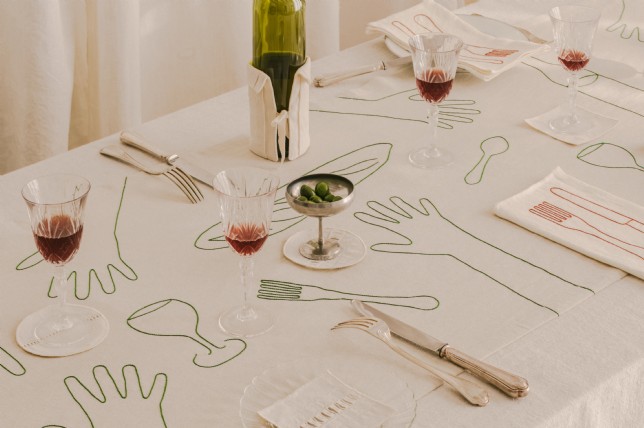

At her Marseille atelier, Œuvres Sensibles, Sarah Espeute and her team of artisans lay the table, dress the windows and drape the beds with needle and thread. On bespoke tablecloths, plates drawn in thread mingle with those laid for lunch. In our conversation, Espeute recalls how family lunches would often spill over into dinner when she was growing up in Arles. For her Paris exhibition A Well-Dressed Apartment, she took the idea of dressing a room quite literally, making curtains in the shape of shirts, trousers and a kimono. Her creative practice is an act of attention made material.
In a world of mass production, Sarah makes playful objects by hand. She learnt to embroider as a child, and her work carries the tenderness of a craft steeped in memory. As we savour the pleasures of staying in, we speak with Sarah about laying the table, dressing our interiors as we might dress ourselves, and how a little trompe-l’œil can make the rituals of home feel special.
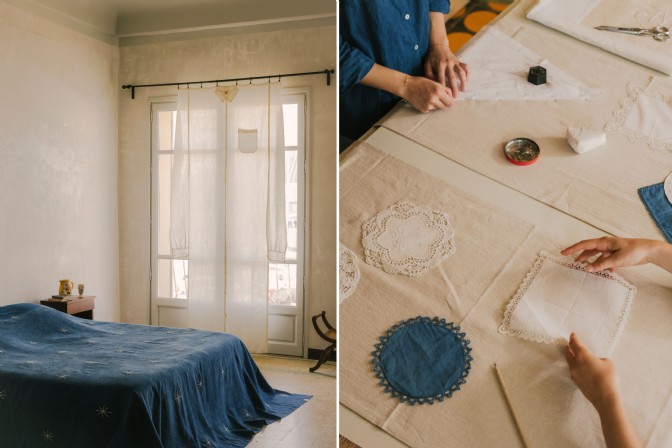
image credit: Maxime Verret
Œuvres Sensibles translates as 'sensitive pieces' – can you tell us a little about this, and what you hope people feel when they encounter your work?
Œuvres Sensibles started as a little manifesto. I wanted to create objects that we develop a real attachment to, pieces that we choose to keep, live with, and perhaps one day pass on to someone else. I believe objects can carry something beyond their function. A memory, a familiar gesture, the presence of someone we love. Sometimes the most ordinary things are the ones that mean the most to us.
Through my work, I hope to create that same feeling of familiarity and sensitivity. I like imagining that a piece might remind someone of a childhood memory, or simply make them smile. And that, over time, it will become part of their own stories.
You've spoken about growing up surrounded by inherited objects. How did that shape the way you think about daily rituals?
My parents have always had a particular affection for objects. My father collected antique plates, while my mother loved al the little things that make a table special: knife rests, napkin rings, bread baskets, beautiful tablecloths. I grew up surrounded by these things, often without thinking much about them. What I find beautiful is that these objects have a way of bringing people together. You take out an old plate for lunch, someone remembers where it came from, and suddenly a conversation begins.
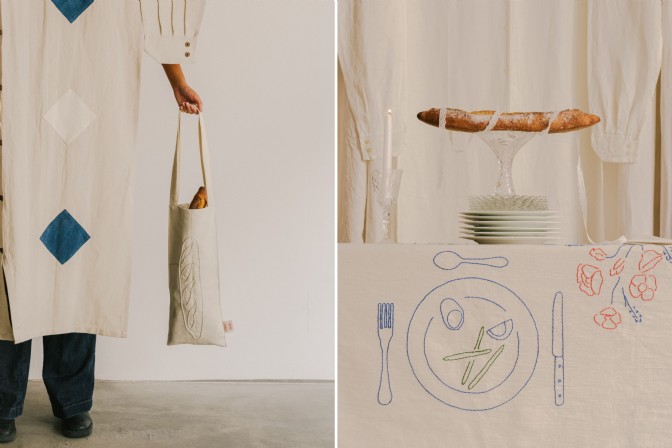
image credit: Maxime Verret
Your work often plays with the binaries of reality and illusion, memory and preservation. What draws you to their edges, and how does it surface in your practice?
I've always loved trompe-l'œil and the idea of creating a little confusion between what is real and what is drawn. When I embroider a plate or a glass onto a tablecloth, I like imagining the real objects being placed next to them.
The composition changes every time someone sets the table. There's something playful about it, and I enjoy that the person using the piece becomes part of the work. The same idea led me to create the Clothing Curtains, which were first imagined for an exhibition in a Parisian apartment. I started thinking about how we dress our interiors, almost as we dress ourselves.
There's an alchemy to transforming old, storied textiles through techniques passed down across generations. What draws you to traditional crafts, and how do you approach reimagining them in your own practice?
I learned embroidery as a child, using very simple stitches, and I still love the fact that you can create something with just a needle, thread and fabric that doesn’t even have to be new. There's something very accessible about it. What I find particularly moving about traditional crafts is the idea of passing knowledge from one generation to the next. These gestures have survived because someone took the time to teach them, and someone else took the time to learn. Without this transmission, many beautiful techniques would simply have disappeared.
At the atelier, we work with hand embroidery, Cornely embroidery, patchwork, appliqué and natural dyeing. I don't necessarily try to modernise these techniques. I prefer using them freely, combining them, and sometimes taking them into unexpected places. A traditional technique can then become part of a very contemporary installation.
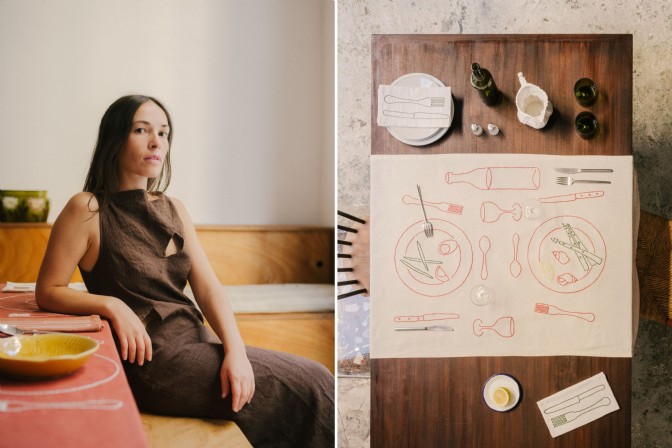
image credit: Maxime Verret
Can you tell us a little about how you source your materials?
I love searching for old textiles at flea markets. I often look for materials that already have a presence. A slightly faded colour, previously embroidered initials, lace, the traces of an old fold or repair. These details make the textile interesting to me.
We also work with (new) natural fibres such as linen, cotton and hemp, sourced from French and European suppliers. Sometimes we give vintage fabrics a new colour through natural dyeing, as we've done for our indigo pieces.
The table is a recurring presence in your work. What does the ritual of gathering around mean to you?
For me, the table is where so much of life happens. I grew up in the South of France (Arles), where meals can last for hours (sometimes lunch can even last until dinnertime!), and where sitting around a table is as much about talking as it is about eating.
My mother and grandmother have always loved setting the table, bringing out beautiful tablecloths, antique plates, knife rests, little doilies and bread baskets. I love how these small, functional objects can dress a table and make even a simple meal feel special. I've kept this pleasure of preparing a table for others.
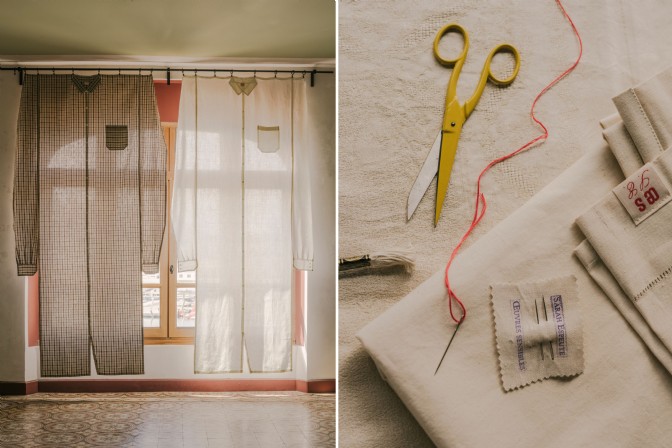
image credit: Maxime Verret
What would your advice be to someone wanting to lend a sense of enchantment or whimsy to their home?
I would say don't try to make everything match or look too perfect. I love interiors where objects have been collected over time, where something inherited sits next to something contemporary, and where you can feel the personality of the people living there. Don’t be scared to show something if it is part of a story: it's important to leave room for things that don't necessarily have a purpose. An object can simply make you smile or remind you of someone/something. For me, that's what makes a home feel alive.
Are there any upcoming projects, exhibitions or collections you'd like our readers to know about?
We're preparing quite a few things at the atelier at the moment! We just presented our work at Artisans d'Excelence in Paris, which was a lovely opportunity to share our approach to textiles and craftsmanship. We've a new series of unique pieces and a small capsule collection for Christmas, 'a table for the holidays' that has just launched along with unique pieces from previous exhibitions.
Another project I'm particularly happy about is the launch of embroidery workshops in our Marseile atelier. More broadly, I want Œuvres Sensibles to continue being a place where I can experiment freely.
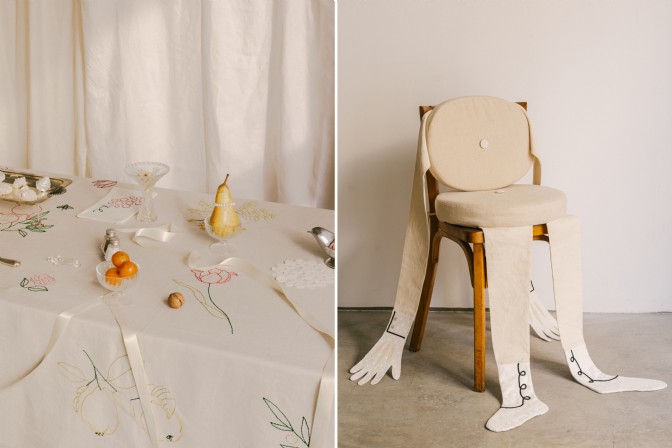
Image Credit: Maxime Verret
With thanks to Sarah Espeute and the team at Œuvres Sensibles for their time and generosity, and to Maxime Verret for the images.
Feeling inspired? Read our recent piece "The joy of missing out" to discover the pleasures of staying in, or peruse our collection Luxury homes with a private chef if you'd like to host something extra special.


