
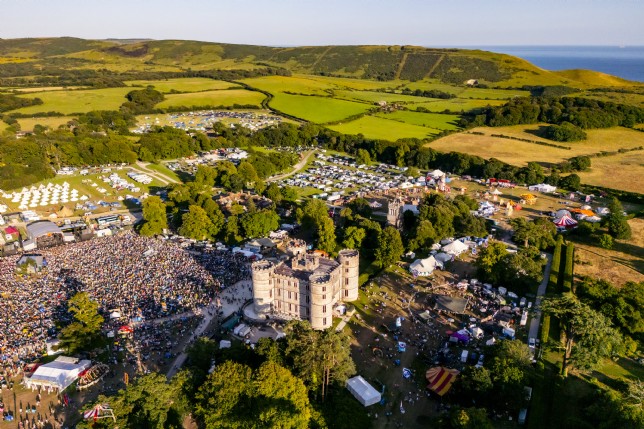

When I speak with Rob da Bank, co-founder of Bestival, there’s just a month until the festival gates open. "Suddenly everything's ramping up," he shares, from somewhere between breakfast and a site planning call. That sense of energy and pace, it turns out, is the foundation of it all, and shows no signs of slowing, apart from the pockets of stillness him and his wife and co-creator Josie have learned are essential. Slomo, their next generation wellbeing brand, grew from that realisation – that a life lived full-tilt requires its own counterrhythm.
This year is Glastonbury Festival’s fallow year, but the da Banks' own festival season dances on just as it has for the past twenty-five years. Over two decades after Rob and Josie dreamed up Bestival in a pub in 2004, a move into party curation Josie has cited as a happy accident, the wonder of it all clearly hasn't worn off. Bestival begat Camp Bestival, raising a generation of festival-going children alongside their own; the spirit of both shimmers through Carnivàle, the pair’s waterfront home on the Isle of Wight. Carnivàle is a house built from the same instincts as their festivals – a reverence for escapism, an open-door policy, and an understanding that the best spaces make room for everyone.
Here, we talk rituals, the art of a great party and what it means to build a home infused with festival spirit.
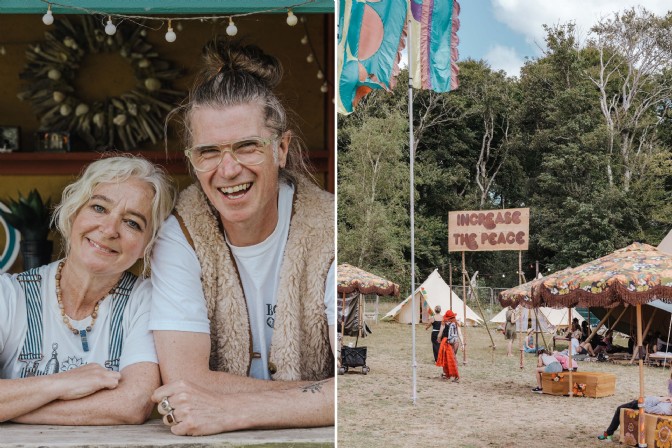
left- Josie and rob da bank. right- camp bestival
How did Bestival begin, and did you have any idea what it would become?
We started in 2004 as hedonistic young people looking to spread some fun and share some love – that's always been our core message. We wanted to create events that were colourful and a bit eccentric, and to celebrate with our friends. Then it got out of control, doubling in size every year, and the Bestival story was born. Four years later, in 2008, we started Camp Bestival because we'd had children ourselves and wanted somewhere we could take them and still have fun, just with an earlier night and a tad less nuttiness. Eighteen years later, we're still going, and our children still love it. I suppose we achieved what we set out to do.
Tracing back over those years of festivals and parties, what moments stand out most – in the field, and at home?
Without being too cliché, it must be those golden moments where you're with your friends at sunset overlooking the sea, or dancing in a field with your youngest on your shoulders and your oldest beside you. There are specific things too: Stevie Wonder and Elton John playing on the main stage, playing a warmup set for The Prodigy in front of 40,000 people, seeing Chuck Berry at Camp Bestival. But, looking back, it's all about those magical memories being made. Josie and I do this for ourselves, our creativity, our family – but the driving force has always been to make people happy. I think we've got some people-pleasing genes in us. It's less a business, more an endlessly evolving art project.
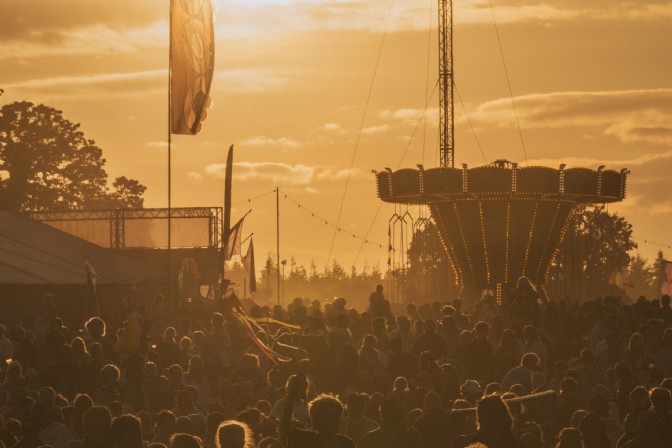
CAMP BESTIVAL
What defines festival spirit for you?
That original spirit we discovered jumping the fence at Glastonbury at eighteen, not paying, thinking it was all laid just on for us – the freedom to party, the freedom to gather in this tribal, ritualistic way. I really believe that the need to come together and celebrate is quite deep within us as a species.
On the Isle of Wight, where our home Carnivàle is, we live by the seasons – through six months of real quiet, almost hibernation, and then a bustling eight months from May to October when the island comes alive. Our festival season runs to the same rhythm: everyone wants to hunker down for winter, then spring arrives and it all opens up again. If we lived in LA we could run festivals year-round, but I think there's something inherently good about that cycle.
After two decades of building some of the UK's most loved parties, what are the key ingredients of a great one?
The people, primarily. Then the location – when we set out to start the festival, we only had six months from having the idea in a pub to opening the gates, so we had to find somewhere quirky and different fast. We sold tickets having no idea who'd turn up, and honestly, we still don't. One of my favourite things, twenty-five years on, is still waiting at the gates as the first people arrive – you could be welcoming 30,000 lunatics or 30,000 of the most incredible people you'll ever meet. Luckily, it's normally the latter. So, the key ingredients are: location, people, music and entertainment, which we're finally getting pretty good at. If you can get two or three of those pieces right, the rest of the puzzle falls into place.
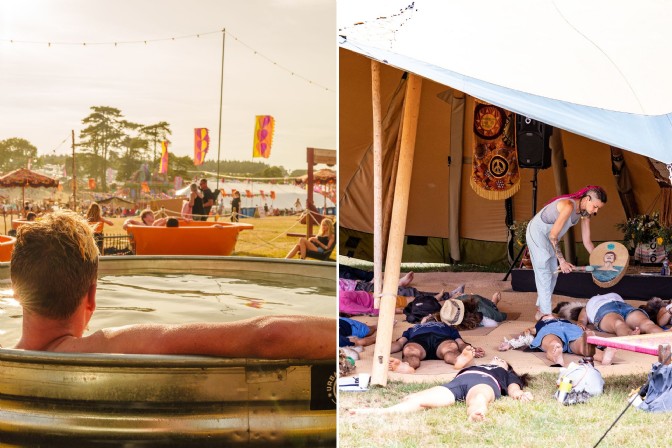
slomo sanctuary at camp bestival
Bestival’s audience spans from newborns to grandparents – without ever feeling watered down. How do you meet everyone’s needs through design?
Everything requires constant tweaking. We've got a breastfeeding tent and a nappy-changing station at one end, and shade and shelter for 80-and 90-year-old grandparents at the other end of the scale. Most of the children attending are between five and ten, so we know fun stuff for that age works, but there are still 16-and 17-year-olds who want to see acts like Self Esteem or De La Soul – so we can't just programme Mr Tumble and call it done. We have an area called Caravanserai, a festival within the festival, which I genuinely think is one of the coolest programmed venues in the world. It comes from that Glastonbury heritage and runs properly left-field, with pop moments like Bastille or Fatboy Slim alongside extreme left-field ones. You might end up dancing to swing and polka at two in the morning, to a band nobody's heard of who turn out to be the best thing you've seen. It’s about creating something for every age group without diluting the whole.
It doesn't feel compartmentalised, either – everything seems to feed into everything else.
That flow comes through the way Josie designs the site. You can duck into any venue and find something good for everyone in there.
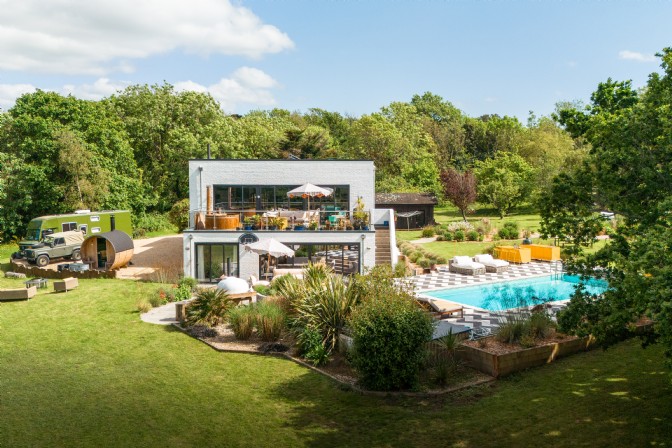
The same flow seems to run through Carnivàle. Tell me about its design, and how you imagine guests using the space.
It reflects our lives, really. The house was built in the seventies – Josie didn't knock it down, she built from its original quirky, modernist bones. Back then, it would have been a strikingly modern house, blocky and square, looking out over the sea. We've taken the best of that slightly futuristic feel and made it comfortable, because we love old things too. So it's a new house filled with old, colourful touches. That extends into the garden, where there are pygmy goats, chickens, caravans and yurts, and down to the seafront, where there are kayaks and paddleboards and of course the sea itself. I swim every single day, snow or sun. I can’t help but think ‘what an incredible thing’, to be able to go swimming in the sea from your own back garden.
For guests, I think it has the wow factor straight away because the location and the property are stunning, but once you settle in it has a very homely feel. One of the unusual things is that its layout is upside down – we live on the top floor, looking out over the sea, and most of the bedrooms are downstairs, which gives it a slightly continental, almost Scandinavian feel. You end up spending a lot of time looking out over the wildflower meadow towards the sea, past the goats and wildlife. It’s a real escape from the norm.
There's something holistic running through everything you've built: in the healing spaces at Camp Bestival, your wellness brand Slomo, the sauna and yoga studio at Carnivàle. How has your relationship with rest and restoration evolved over the years? What does slowing down actually look like for two people who have spent decades orchestrating joy for others, for people who started out so firmly on the side of revelry?
That's the million-dollar question, and something I battle with every day, in a good way. Part of me moves far too quickly – a million ideas a minute, and Josie's the same; we were born a day apart in the same year, which might explain something. We're both hardworking and always generating new ideas, but on the flip side we desperately want to relax and enjoy what we've built. Slomo – short for slow motion – was born from us trying to push ourselves into actually slowing down. The wellbeing scene in the UK is moving apace, and we're along for the ride, which is exciting but relentless… it reminds me of when we first started festivals in the early 2000s, that gold-rush feeling.
Beyond Slomo, Josie and I each have our own wellness practices. I swim in the sea every day, meditate twice a day and teach meditation, which grounds me. Josie is a yoga teacher. We've spent thirty-five-odd years together, always working together and are never really ‘off’. Even at 10pm we'll still be spilling over with ideas. It’s not always healthy, but we're always on, with little pockets of slowing down built in.
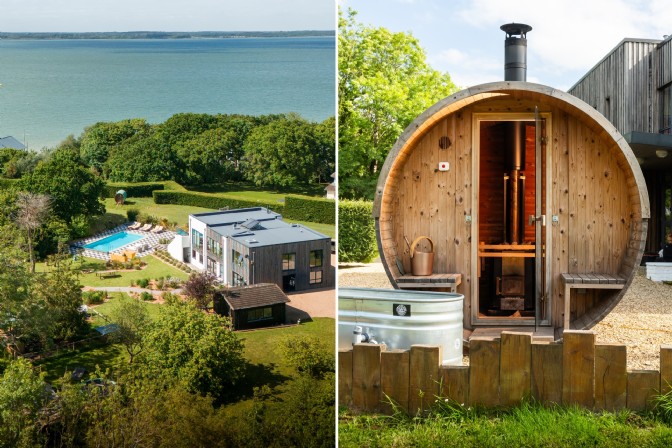
Is there anything else you'd like to share about Carnivàle?
Living here is a real escape – much like the festivals, or my radio show, or DJ sets. They're all escapes from a reality that we all know can oftentimes be quite brutal. Whether its friends coming over or guests staying for a week, that's the feedback we hear most: the feeling of escape, however long it lasts. Being surrounded by the forest next door, the sea in front, the wildflower meadow, the red squirrels, our own goats and chickens – I think that's the house's biggest strength, that it's restorative. But it's also still a party house. With the pool, the sauna, the yoga room and everything else, it's endlessly versatile.
With thanks to Rob and Josie da Bank for their time, generosity and images.
Feeling inspired? Explore Carnivàle, browse our full collection of large homes for hosting, or read our feature on where to continue the party during Glastonbury's fallow year.


