

A building can remember. It remembers in the form of initials etched into a timber beam, the curve of a staircase made smooth by generations of feet, and the view framed by a window that has outlived those who first looked through it. To step inside is to inhabit a small piece of the past, and, for a while, to become part of its story.
Across Britain and Ireland, there are homes whose stories stretch back centuries. Some have known profound hardship; others, great privilege. They have witnessed the changing fortunes of the landscapes and communities around them – shaped by conquest and crowns, poverty and protest, industry and innovation.
Here, we look at four remarkable examples, from a County Kerry cottage that defied its violent destruction to a Norman castle in Cornwall that has watched nearly a millennium pass beneath its walls. What makes these houses remarkable is not simply that they have survived – preserved as relics sealed behind glass and rope – but that they remain living, evolving spaces. They retain the marks of their past lives whilst making room for further chapters, restored and reimagined for new generations to experience and create memories of their own.
Limehouse Cottage, County Kerry
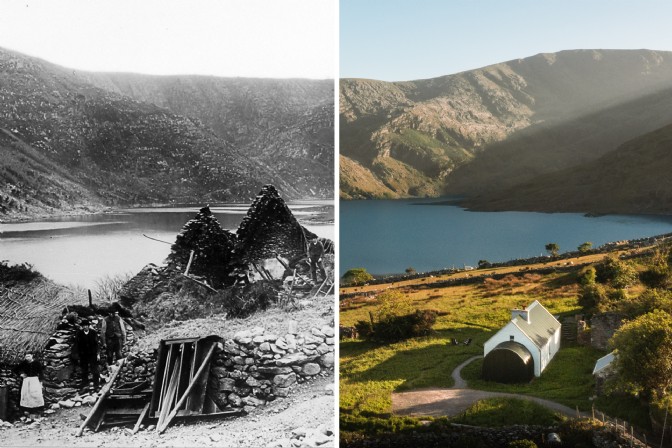
Image credit: Richard Gibson, Quirke's Cottages, Coomasaharn, c. 1887. Reproduced courtesy of the National Library of Ireland (NLI Ref. EB2657). Via Flickr Commons.
Limehouse Cottage stands today as a survivor. Built as a modest dwelling in the remote parish of Glenbeigh, County Kerry, it was a home shaped by rural life, with farm workers housed at one end and livestock at the other. Across Ireland in the late 19th century, many families lived on small rented holdings such as these, dependent on the success of each harvest and their ability to meet the demands of their landlords. The shadow of the Great Famine of 1845-1852 still would have haunted the memories of surviving communities. In the following decades, economic recession, crop failures and mounting rent arrears once again pushed tenant farmers into crisis, fuelling the conflict that became known as the Land War.
In the winter of 1887, Glenbeigh became the focus of international attention when an estate owner sought to recover mounting rent arrears from his struggling tenants, resulting in court orders for the eviction of 70 of them. Contemporary newspaper reports paint a chilling picture of the weeks that followed. Supported by a large police force, bailiffs moved from house to house, forcing families from their homes before setting cabins alight or tearing down their walls.
Amongst those caught up in the destruction was the home of the Quirke family, now known as Limehouse Cottage, generations of which had lived there for decades. As the authorities advanced, the tenants here resisted with remarkable courage. One reporter from The Freeman's Journal explains that “to get at their eyrie, several deep and rapid streams had to be forded”, but “the boys of the locality had carefully removed the stepping-stones which were the only means of crossing.” This forced the police and bailiffs to make a detour of several miles on their way there, and to cross waist-high water on their return, which “afforded amusement to the crowds of onlookers.” The reporter also recounts the struggle of a woman and her daughter to defend their home, writing that “so desperate was the resistance offered the evictors by the two women that it required the efforts of a dozen policemen to remove them.” He continued that “the young girl displayed great heroism, caring not a jot for the levelled bayonets of the police.”
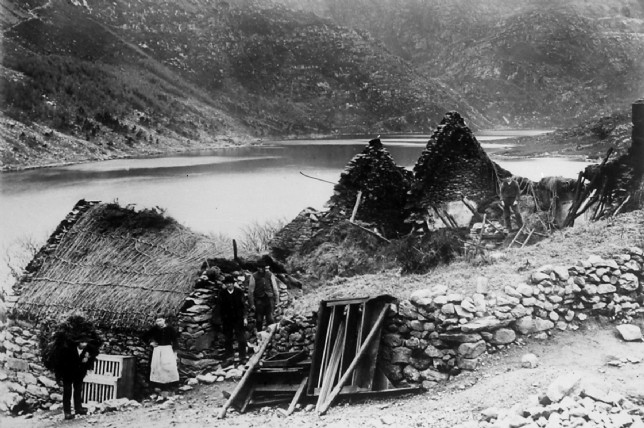
Although Limehouse Cottage was partially destroyed during the Glenbeigh Evictions, as pictured in the photograph above, it survived through the determination of those who refused to leave. The tenants rebuilt their home stone by stone, transforming an act of destruction into a testament to resilience and defiance.
Over a century later, Limehouse Cottage entered a new chapter. Its current owner, Catherine, fell in love with the Glenbeigh landscape as a child, spending family holidays in the area during the 1970s and swimming in Coomasaharn Lake. Years later, whilst searching for a cottage to restore, she knew from her first visit that this was the one. Beneath layers of later alterations, the original stone walls revealed the traditional dwelling. Restored with natural materials including lime render, lime plaster and hemp insulation, the cottage has been skilfully transformed whilst preserving the character and craftsmanship of its past. Two contemporary additions now sit in harmony with the original cottage: a curved green corrugated-iron barn that echoes the agricultural buildings scattered throughout the Kerry landscape, and a glass box that turns the mountains and lake into a living backdrop. The result is a sensitive balance between memory and modernity.
Castle Trematonia, Cornwall
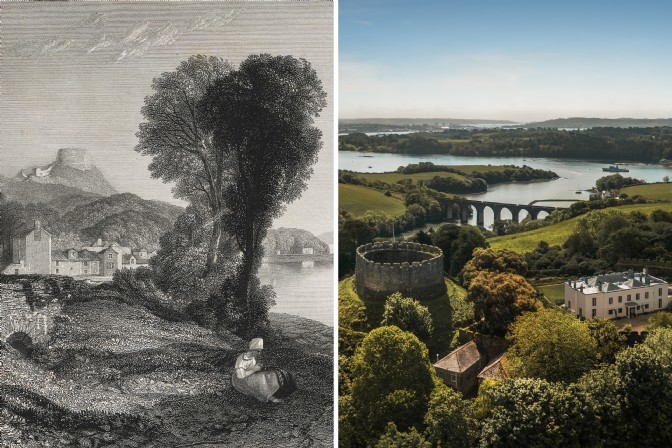
Image credit: Robert Wallis, Trematon Castle, Cornwall, 1830 – Yale Center for British Art (Public Domain/CC0). via Rawpixel.
Rising above the Tamar Estuary, Castle Trematonia occupies a commanding position. Built in 1068 by Robert, Count of Mortain, half-brother of William the Conqueror, the Norman fortress was created in the aftermath of the Battle of Hastings to strengthen Norman control over Cornwall. Sitting atop what was once an ancient pagan site, the castle was built as a gateway between Cornwall and the rest of England – a strategic stronghold that never actually saw battle.
For centuries, the castle belonged to the Duchy of Cornwall, passing through royal hands and gathering stories along the way. In 1337, it was bestowed upon Edward the ‘Black Prince’, for whom the Grade-I listed gatehouse was built. Legend later linked the castle to one of the most colourful episodes in its history: the arrival of Sir Francis Drake’s treasure. After his circumnavigation of the globe, Drake is said to have stored a hoard of gold, silver and emeralds, looted from Spanish ships, at Trematonia before it was transported to the Tower of London.
By the early 19th century, the castle had fallen into decline. In 1807, naval officer Benjamin Tucker was granted a 100-year lease by the Duchy of Cornwall and set about creating a Georgian home within the medieval walls. Completed in 1808, the house reflects his admiration for renowned architect Sir John Soane, evident in its elegant symmetry and light-filled interiors. Further changes followed, including the removal of part of the medieval castle wall to open up views across the landscape and the creation of an ornate swimming pool in the gardens to commemorate a visit in 1812 by the Prince Regent, later George IV.
Pictured above, an 1830 engraving by Robert Wallis reveals that the castle dominated the wider landscape much as it had since the Norman Conquest – and still does today. Generations of farmers, fishermen, labourers and estate workers would have looked up to its ancient keep as they worked the fields or crossed the river. In the foreground, a young woman rests. Whether dairymaid or castle servant, she reminds us that the story of this historic building is not only one of princes and privateers, but also of the ordinary people who lived, worked and raised families beneath its enduring presence.
Today, Castle of Trematonia has been lovingly restored by House of Hackney founders Frieda Gormley and Javvy M Royle, who first discovered it whilst attending the opening of its gardens and were immediately captivated. Inspired by the surrounding landscape, the interiors are now filled with their signature botanical prints, rich natural tones and carefully chosen pieces by British artisans. Mossy greens, lilacs, clay pinks and earthy reds echo the colours of the subtropical gardens outside, whilst House of Hackney fabrics and wallpapers bring theatricality and imagination to each room.
Beyond the house lie nine acres of private gardens, formerly tended by celebrated garden designers Julian and Isabel Bannerman, combining romantic meadows, ancient woodland, orchards and exuberant borders filled with roses, peonies, lilies, herbs and wildflowers. Meanwhile, the fortress continues to watch over the estuary, just as it has for almost a thousand years, now housing the family’s chickens.
Isla Windmill, Isle of Anglesey
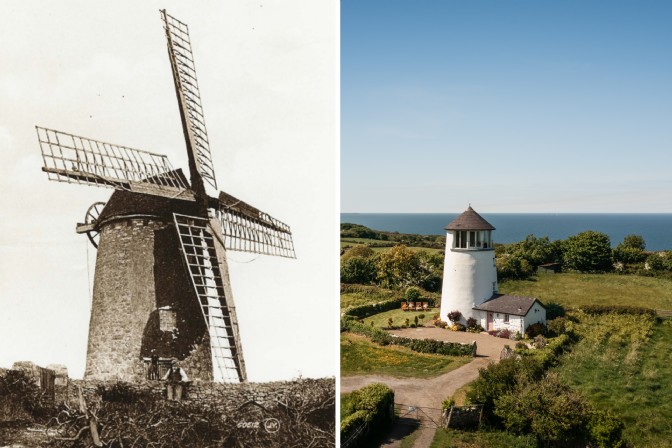
Image credit: ISLA WINDMILL – COURTESY OF JULIAN WOOD.
Standing proudly since 1741, Isla Windmill looks out across the Menai Strait towards the dramatic mountain peaks of Eryri (Snowdonia) National Park. One of the Isle of Anglesey's earliest surviving tower windmills, it has stood watch over this landscape for nearly three centuries. In its heyday, it would have been a hive of activity at the heart of the local farming community, its sails harnessing the island's coastal winds to grind grain into flour for neighbouring farms. Inside, the creak of timber gears, thunder of millstones and ever-present haze of flour dust formed the backdrop to the miller's daily life. Dependent on both the weather and the harvest, the mill was an essential part of the local economy, providing a vital service to the surrounding community long before mechanised farming transformed rural Britain.
Like many historic buildings, however, its future once looked far from certain. By 1926, the windmill's working life had come to an end; its machinery and metalwork were sold for scrap, leaving the tower empty and exposed to the elements for decades. A new chapter began in 1960 when civil engineer Stanley Flory purchased the abandoned building for £800. He removed the top of the tower to install a galvanised steel water tank, pumping water from a nearby well to serve both his own home and a neighbouring property. Shortly afterwards, the windmill was granted listed status, recognising its historical significance.
When the current owners acquired the property in 1998, they found a building that had fallen into severe disrepair. Yet beneath the neglect lay the bones of an extraordinary piece of Welsh heritage, and a painstaking restoration soon began. Decades of flour dust still coated the interior walls, which had also become saturated with moisture and stained green with algae after years of exposure. As the clean-up got underway, the missing top floor was rebuilt and space was created for a new staircase. Completed in May 2007, the restoration skilfully marries old and new. A contemporary kitchen and bathroom extension was constructed using Penmon limestone discovered partially buried in one of the owners' own fields. The stone was given a second life throughout the project, with a local stonemason also crafting the front doorstep and the gate piers, rooting the restoration firmly in the landscape and traditional craftsmanship of Anglesey.
Today, Isla Windmill stands as an example of sensitive conservation – transforming a forgotten, derelict structure into an extraordinary home whilst safeguarding an important piece of the island's architectural heritage for generations to come.
The Signal Station, Cornwall
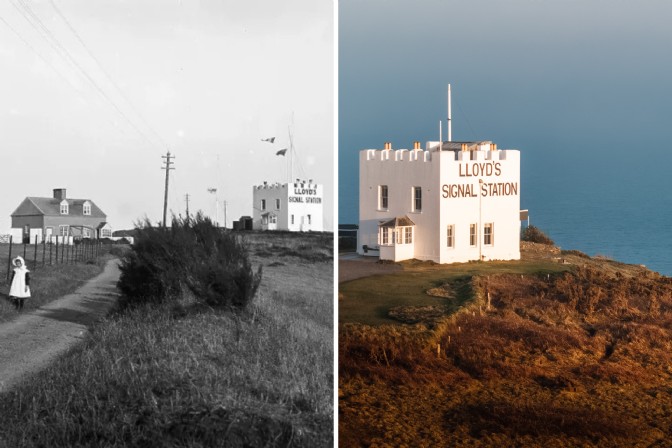
Image credit: LLOYDS SIGNAL STATION, BASS POINT, THE LIZARD, LANDEWEDNACK, CORNWALL, EARLY 1900S. © ARTHUR WILLIAM JORDAN/MEDIA STOREHOUSE.
On Cornwall's Lizard Peninsula, The Signal Station is an enduring landmark of Britain's maritime past. Built in 1872 by Fox and Company shipping agents, this striking white stone building was created as a communication hub for passing trading vessels navigating this stretch of coastline.
Within just five years, the station was being used by more than 1,000 ships a month and had become so important that Lloyd's of London, the maritime insurance market, assumed responsibility for its operation in 1883. The iconic main wall of the building still displays its former name, Lloyd's Signal Station. Here, a team of signalmen scanned the horizon, exchanging messages with passing vessels through a system of flags. Details of ships' names, movements and destinations were then passed to the telegraph room below, where they were sent to owners and the daily newspapers, removing the need for vessels to call into Falmouth in order to report their progress. The building became a vital link between land and sea, connecting ships travelling across the Atlantic with the people waiting for news of their journeys.
The station’s story is also inseparable from the challenging waters it overlooked. On one of its walls, two red lines remain painted as a visual marker for passing boats, indicating the position of ‘Rogue Rock’ – a treacherous outcrop that rises just above the water. But, in choppy conditions, can become almost impossible to see, and has consequently been the cause of many historic shipwrecks.
The Signal Station ceased operating in the 1950s. Ironically, the very technology that would eventually replace traditional signalling was pioneered just a short walk away at the Marconi Hut. It was here that the first radio signal sent from beyond the horizon was received, as well as the first SOS distress signal, ushering in a new era of ship-to-shore contact.
In 2018, the building was carefully restored by its current owners Anna and James, with great sensitivity to its listed status. Whilst the exterior remains virtually unchanged since 1883, the interior has been thoughtfully reimagined as a contemporary coastal retreat. The design pays homage to the building's maritime heritage through subtle nautical details: tongue-and-groove panelling, striped soft furnishings, a driftwood light fitting crafted from beachcombed timber, and a palette of neutral tones that allow the ocean to take centre stage. Each bedroom has been carefully designed to make the most of the setting, with built-in window seats offering a quiet place to sit and watch the changing sea and sky.
As for the original flagpole platform, that has been transformed into a roof terrace. Looking out across the Atlantic Ocean, it offers the same vast expanse of sea that the signalmen once watched over, although its purpose today is vastly different. Guests can now relax with cocktails from the crow’s nest home bar, watching the sky above the Atlantic shift from burnt orange to deep indigo as the sun sets beyond the horizon.
Feeling inspired? Peruse our full collection of unique private rental homes or read about our Footsteps through folklore across the UK and Ireland next.


