
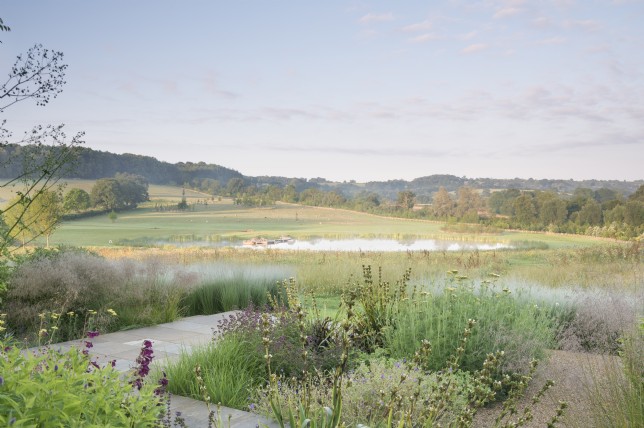

We have long pondered the visual and symbolic language of flowers and how the homes in our collection nurture the landscapes around them. This reciprocal relationship between aesthetics and nature is a provocation that sits at the heart of Marcus Barnett Studio’s practice. A three-time RHS Chelsea Gold Medal winner, Marcus Barnett established his London-based studio some 20 years ago with a philosophy rooted in ecology, place and a borderless dialogue between interior, garden and land. The studio brings together a handpicked team of designers, plantspeople and construction specialists, each contributing a distinct strand of expertise and ensuring no two gardens are the same.
Here, we speak with Marcus and garden designer Amy Derby about the studio’s practice and how that philosophy came to life at Nightjar, our contemporary Cotswolds property whose garden was shaped by the studio.
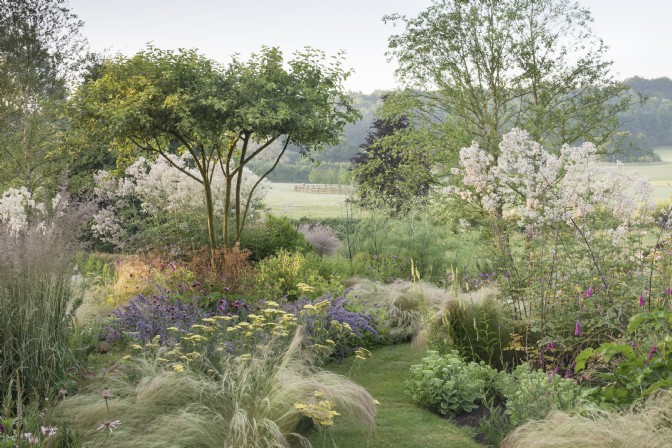 image credit: mimi connolly, of "Oxfordshire Barn"
Marcus Barnett Studio describes its landscapes as refined habitats; spaces that appear restrained on the surface but reward closer attention. What does that mean in practice?
“Deceptive simplicity underpins each design,” says Marcus, “but on close examination there are multiple layers – in both the layout of the design itself and the planting palette that defines it.”
Amy elaborates: “so much detail goes into each of those final decisions. When the many layers are fully coherent, the result is a space that feels very comfortable – it might seem simple, but that’s because we have worked as hard as possible to ensure that every element of the architecture is in harmony with the landscape, which in turn is coherent with the wider surroundings." In a perfect garden, she says, "it all just feels like it fits.”
Your philosophy speaks of ‘ordered disorder.’ Can you describe what that looks like – in planting choices, hard landscaping and the relationship between geometry and growth?
“Plant palettes vary from project to project and, often but not always in our designs, the design framework is softened and juxtaposed by the vagaries of planting,” says Marcus, “palettes offer varied tone, texture, colour and seasonal change.” What interests the studio, Amy adds, is “how a considered structure can allow planting to do what it naturally wants to do – to spill, to seed, to respond to the season. The result is a garden that looks alive because it is.”
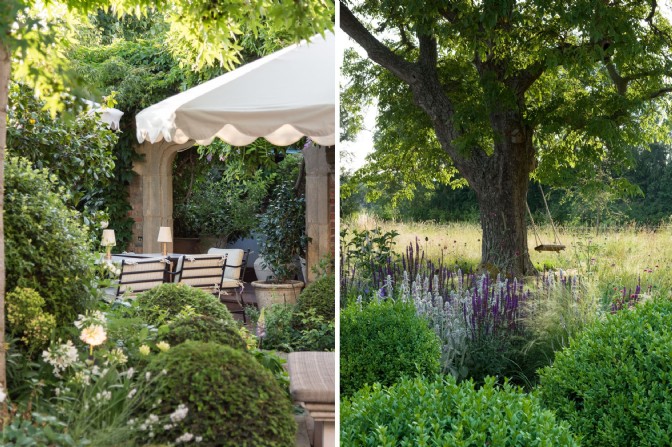
Image credit: left- Mimi connoly, of "the roof gardens". right- Jerry Harpur, of "cotswolds barn"
You work with a restrained palette drawn from local materials, plant communities and traditions. How does that process begin when you first encounter a new site?
“We always undertake a thorough site analysis,” says Marcus, “that elicits an intimate knowledge of the area and the wider context of the surrounding landscape.” The local vernacular and architecture of the site, he says, is a pivotal point of reference. “We listen to what is already there – in the soil, the light, the surrounding plant communities – and let that inform every decision that follows.”
“You are constantly referring to different elements of the materiality and design style of the architecture,” Amy adds, “whilst also considering that transition out into the wider landscape – so that the whole garden feels like it always should have been there.”
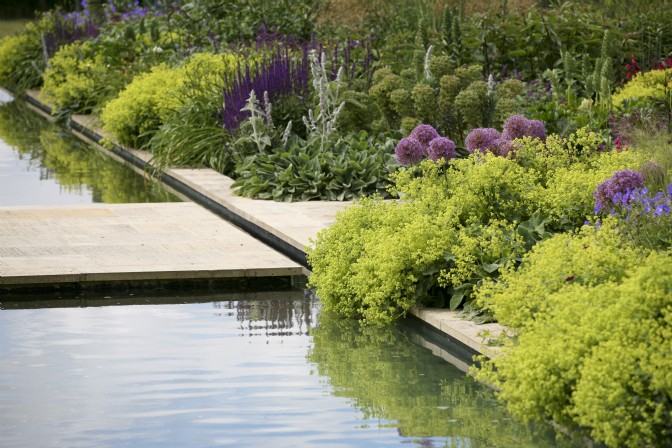 IMAGE CREDIT: JERRY HARPUR OF "COTSWOLDs BARN"
Biophilic design has become a significant presence in architecture and interiors – the idea that our physical and psychological wellbeing is deeply tied to proximity to nature. How do you design for a reciprocity between nature and design?
“There is always a spirit of the place,” says Marcus, “and whatever this may be, we hope that the design leverages the unique elements present and that our design reinforces this spirit. We hope therefore we can establish a dialogue between property and garden, garden and landscape."
For Amy, that reciprocity is most visible in the studio’s ecological approach. “You are not just creating a beautiful garden; you are creating a habitat. All of our gardens are designed to look wonderful in every season – structure and seed heads carrying interest through winter, but also providing for the fauna and insects that depend on that space. How much can the garden give back? That question is always present.”
“There has been a significant move in the industry towards rewilding,” she continues. “Meadows and spaces that we allow to grow naturally, to bloom, to go to seed before cutting back in winter – it allows periods of structure and periods of abundance, and it blends so beautifully into the surrounding landscape. Getting clients to really invest in that, to believe in it, is one of the most rewarding parts of what we do.”
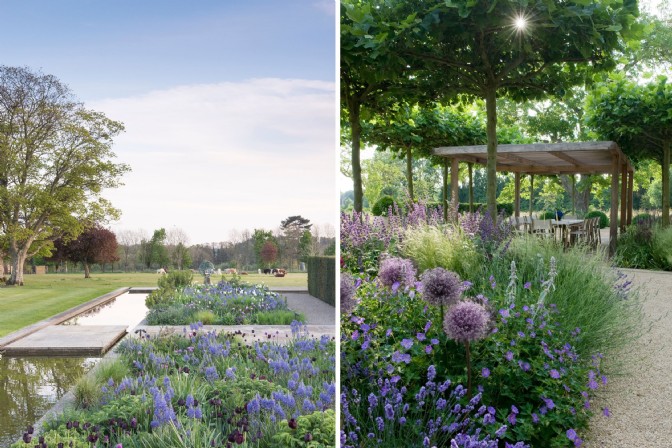
Image credit: Left- Mimi Connolly of "the cotswolds barn". Right- Jerry Harpur of "the cotswolds barn"
Who and what inspires the studio – and what caught your eye at this year’s Chelsea Flower Show?
The studio draws its inspiration closely from the landscapes and architectures of each site. "The local vernacular and architecture of the site is a pivotal and inspirational point of reference." shares Marcus. "As for the Chelsea flower show, there's invariably a zeitgeist that flows from year to year."
“Chelsea is always a little picture point of where everyone’s feelings towards garden design are sitting,” Amy concurs. “This year, the shift felt significant – a lot more actual garden spaces, considered and structured, but with that same emphasis on natural planting, sustainability and the reuse of materials. The direction of travel feels very much in line with what we have been working towards.”
A particular highlight for Amy was the garden by Patrick Clarke, a consultant who works closely with the studio and was awarded a Gold Medal at this year’s show for the Children’s Society Garden – adding to the studio’s own proud Chelsea history.
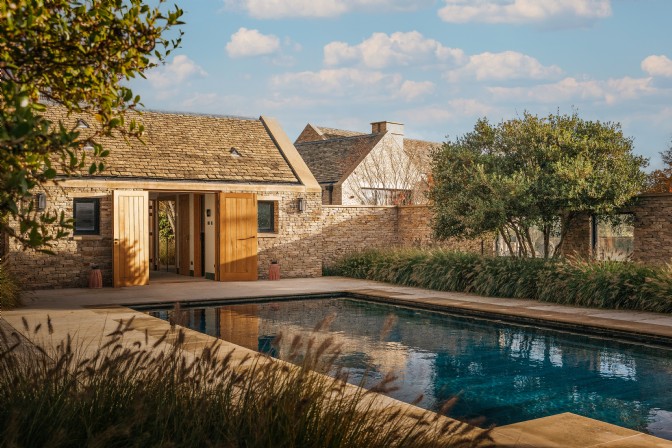 IMAGE CREDIT: UHS Of Nighttar's pool courtyard planting.
You shaped the garden at Nightjar, one of our properties in the Cotswolds. Can you take us through that project?
“The modern architectural and interior design of Nightjar had to be reflected and reinforced in the landscape,” says Marcus. “Rectilinear design, planting monoculture and contemporary design elements were paramount." Examples of this in the property's grounds include "the perpendicular layout, the bold simplistic grasses and single species trees [that] echo the architecture" whilst the "sculpture, lighting and the borderless interplay between internal and external thresholds emphasise design harmony.”
Amy takes us through the specifics: “We were designing the garden alongside the architects, working closely on materials from the outset. The same stone used in the garden walling is the same stone used in the construction of the building, laid by the same team at the same time. Polished concrete flows throughout the ground floor and runs seamlessly out into the landscape – that continuity was fundamental.”
“The planting is a monoculture of Pennisetum – beautiful, soft grasses with gorgeous seed heads that move in the breeze and carry through every season,” she continues. “In spring, bulbs provide an early pop of colour. The single-species trees – Zelkova serrata 'Flekova' – turn the most extraordinary amber and umber in autumn; colours that echo and intensify the warmth of the stone. From Nightjar you look straight out over the wider estate. That sea of grass softens the transition into the landscape. It doesn’t feel like garden and then wild. It feels like one continuous space – which is, ultimately, what we are always reaching for.”
With thanks to Marcus Barnett, Amy Derby and Martha Ellemann for their time and generosity, and to Mimi Connolly, Millie Pilkington and Jerry Harpur for the imagery.
Feeling inspired? Explore Nightjar, browse our full collection of secret garden escapes, or read our recent piece on homes that nurture the landscape.


